A dying tree does not always look dead. In fact, many trees that are weeks or months from failure still have green leaves and appear perfectly normal at a glance. The warning signs are subtler: peeling bark, fungal growths at the base, branches that snap instead of bend, or a trunk that leans in a new direction. Knowing these signs, and acting on them early, is the difference between saving a tree with treatment and calling for emergency removal after it drops a limb on your car. In the greater Chattanooga area, where mature hardwoods tower over homes, driveways, and power lines, catching decline early is not just a landscaping concern. It is a safety issue. At Urban Tree, we have served East Tennessee homeowners and commercial property managers since 2013, and our professional arborists see these warning signs every week. Here are the seven most reliable indicators that your tree is in trouble, along with specific steps you can take for each one.
1. Why Is the Bark Peeling or Falling Off My Tree?
Healthy bark is a tree’s armor. It protects the living tissue underneath (called the cambium layer) from insects, disease, and weather. When bark begins peeling away in large sections, cracking deeply, or falling off in chunks, the tree is telling you something is wrong.
Some bark shedding is normal for certain species. Sycamores, birches, and some maples naturally shed outer bark as they grow. But if your oak, hickory, or pine is losing bark in patches, exposing dry or discolored wood underneath, that is a problem. It often signals fungal infection, frost damage, or sunscald (a winter injury where temperature swings crack the bark on the south-facing side of the trunk).
What to do: Contact a professional arborist to inspect the exposed areas. If the cambium underneath is still green and moist, the tree may recover with proper care. If the wood is dry and brown, the damage may be too advanced for treatment.
2. What Do Mushrooms Growing at the Base of a Tree Mean?
Mushrooms and other fungal fruiting bodies growing at the base of a tree or on the trunk are one of the most reliable indicators of internal decay. The visible mushrooms are just the reproductive structures. The real problem is the network of fungal tissue (mycelium) working through the heartwood or roots inside.
Not every mushroom growing near a tree is a death sentence. Some fungi are saprophytic, feeding on dead organic matter in the soil without harming the living tree. But bracket fungi (also called shelf fungi or conks) growing directly on the trunk or root flare almost always indicate advanced internal rot. In East Tennessee, we have seen Ganoderma and Inonotus species show up frequently on declining oaks and maples.
The U.S. Forest Service estimates that fungal decay is responsible for approximately 70% of all tree structural failures. That number makes mushrooms at the base of your tree worth taking seriously.
What to do: Do not remove the mushrooms and assume the problem is solved. The fungus could be inside the tree. Call an arborist to assess the extent of internal decay. They may use a resistograph or similar tool to measure how much solid wood remains.
3. Why Are There Dead Branches in the Crown of My Tree?
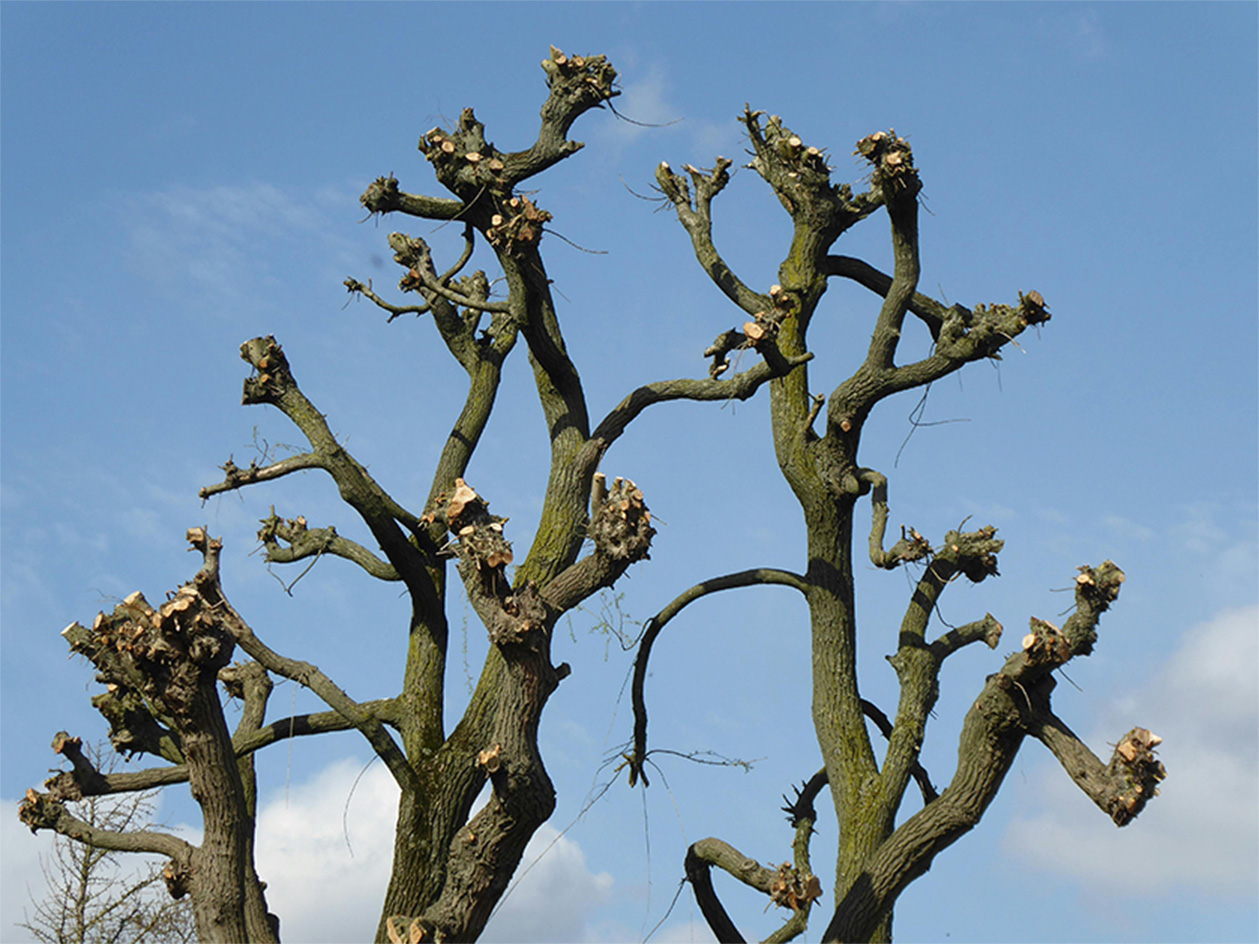
A few dead twigs in the upper canopy are normal, especially in older trees. But when entire branches, particularly large ones, are bare while the rest of the canopy is leafed out, that pattern (called crown dieback) signals declining health.
Crown dieback usually starts at the tips of branches and works inward. It can be caused by root damage, drought stress, soil compaction, disease, or insect infestation. In Chattanooga’s clay-heavy soils, root suffocation from poor drainage is a common trigger.
What to do: Have the dead branches pruned by a professional to reduce weight and prevent them from falling. Then have the arborist investigate the cause. If the dieback is limited to one section, the tree may respond well to targeted treatment. If it is spread across more than 30% of the crown, the tree may be in irreversible decline.
4. What Does It Mean When a Tree Starts Leaning?
A tree that has always grown at an angle is not the same as a tree that is newly leaning. Gradual lean over decades is normal and the tree has compensated structurally. A sudden lean, or a lean that has increased noticeably over a short period, is a serious warning sign.
New lean usually means the root system is failing. Roots on one side may have died, rotted, or been severed by nearby construction. When roots lose their grip, the tree begins tilting, and at that point, catastrophic failure can happen with the next heavy wind or rain-saturated soil.
Look for exposed roots on the side opposite the lean, soil heaving or cracking at the base, and any recent construction, grading, or trenching near the tree’s root zone.
What to do: If a tree has developed a new lean, call a tree care professional immediately. Do not wait. This is one of the situations where timing matters. A newly leaning tree near a home, driveway, or power line is an emergency-level concern.
5. Why Is My Tree Dropping Leaves Early or Producing Small Leaves?
When a tree drops its leaves weeks before fall, or when the new leaves come in smaller than normal and pale in color, the tree is struggling to produce enough energy to sustain itself. Leaves are the tree’s food factory. Small, pale, or sparse leaves mean the factory is running at reduced capacity.
Common causes include root damage, nutrient deficiency, drought, compacted soil, and disease. In East Tennessee, we see this a lot in trees that have had their root zones paved over or heavily compacted by vehicle traffic. The roots cannot access water and oxygen, and the tree slowly starves.
What to do: A soil test is a good starting point. It will reveal nutrient deficiencies that can be corrected with targeted fertilization. An arborist can also evaluate whether root zone decompaction (a process that loosens compacted soil with pressurized air) could help. If disease is the cause, identification and treatment need to happen quickly.
6. What Are Those Cracks Running Down My Tree’s Trunk?
Vertical cracks in the trunk (called frost cracks or stress cracks) can appear after severe temperature swings, storm damage, or internal structural failure. A single narrow crack is not always an emergency, but deep cracks, multiple cracks, or cracks that are widening over time are cause for concern.
Cracks weaken the trunk’s load-bearing capacity. A tree trunk works like a column. When that column has a deep crack running through it, the force of strong winds or hail can split the trunk open along the crack line.
What to do: Have the crack evaluated by a professional arborist. They will assess the depth, location, and whether the crack is active (still growing). In some cases, cabling or bracing hardware can add structural support. In others, the risk is high enough that removal is the safer choice.
7. Why Are Insects Swarming My Tree?
Heavy insect activity, especially boring insects like emerald ash borers, bark beetles, or ambrosia beetles, is a strong indicator of declining health. Healthy trees produce chemical defenses (sap, resin) that repel most insect attackers. When a tree’s defenses weaken from stress or disease, insects move in.
Look for small round exit holes in the bark, sawdust-like frass on the trunk or ground below, woodpecker activity (woodpeckers feed on boring insects), and sap oozing from holes in the bark.
In East Tennessee, the emerald ash borer has been a particular concern. This invasive beetle has killed hundreds of millions of ash trees across the eastern United States since its accidental introduction in the early 2000s. If you have ash trees on your property, annual monitoring is worth the investment.
What to do: Identify the insect species first. Some infestations can be treated with targeted insecticides or systemic treatments injected into the tree. Others (like advanced emerald ash borer infestation) may be too far gone for treatment. An arborist can tell you whether intervention will help or whether removal is the practical option.
When Should You Call a Professional?
If you notice any one of these seven signs, it is worth having a professional look at the tree. If you notice two or more on the same tree, call sooner rather than later. Early intervention can save trees that would otherwise need to be removed, and it can prevent expensive property damage or personal injury from an unexpected failure.
At Urban Tree, we provide professional tree inspections and tree risk assessments for residential and commercial properties across the greater Chattanooga area. Our professional arborists can evaluate your trees, identify problems, and recommend the right course of action. Call (423) 322-9236 or visit geturbantree.com to schedule an inspection.
Frequently Asked Questions
Can a dying tree be saved?
It depends on the cause and how far the decline has progressed. Trees with early-stage disease, nutrient deficiencies, or limited crown dieback often respond well to treatment. Trees with advanced internal decay or severe root loss are harder to save and may need to be removed for safety.
How fast can a tree go from healthy-looking to dangerous?
Surprisingly fast. A major storm can compromise a root system overnight. Boring insect infestations can kill a tree in a single growing season. Internal decay can progress for years without visible signs and then result in sudden structural failure. Regular inspections catch these problems before they become emergencies.
Should I remove a dying tree myself?
No. Removing a compromised tree is far more dangerous than removing a healthy one because the wood is weaker and less predictable. A branch that looks solid may be hollow inside. Professional tree removal crews have the training, equipment, and insurance to handle these situations safely.
How often should I have my trees inspected?
Every three to five years for general health monitoring. After major storms, construction near the root zone, or the appearance of any warning signs listed in this article, schedule an inspection right away.