Storm damage from trees is one of the most expensive and preventable property losses homeowners face. A single fallen limb can crush a car, tear through a roof, or knock out power to an entire street. In the greater Chattanooga area, spring storm season brings heavy winds, downpours, and the occasional severe thunderstorm that puts every mature tree on your property to the test. The good news is that most storm-related tree failures are predictable. Dead branches, weak branch unions, root damage, and internal decay all leave warning signs that a trained eye can catch before the next big storm arrives. At Urban Tree, we have spent over a decade helping Chattanooga homeowners and commercial property managers prepare their trees for severe weather. Here is what storm prep looks like, what to check on your own, and when to call in a professional.
Why Do Trees Fail During Storms?
Healthy, well-structured trees are remarkably good at handling wind. They flex, shed small branches, and distribute force across their root systems. The trees that fail during storms almost always have a pre-existing weakness that made the failure inevitable. The storm was just the trigger.
The most common failure points are dead branches (they have lost their flexibility and snap instead of bending), co-dominant stems (where two main trunks share a narrow V-shaped attachment that splits under load), root damage from construction, soil compaction, or decay, and internal trunk rot that hollows out the tree’s structural core. According to the Tree Care Industry Association, over 80% of weather-related tree failures involve one or more of these pre-existing conditions.
That is the frustrating part. Most of these failures could have been prevented with a pre-storm inspection and targeted pruning or removal. The tree looked fine from the street. Nobody checked until it was too late.
What Should You Inspect Before Storm Season?
You do not need to be an arborist to spot obvious warning signs on your own property. Walk your yard and look up. Really look. Most homeowners pass their trees every day without actually examining them. Here is what to check:
Start with dead branches. Any branch that has no leaves during the growing season, has peeling or missing bark, or snaps (rather than bends) when you can reach it is dead wood that will come down in a storm. Large dead branches over your house, driveway, deck, or where your kids play should be a priority.
Next, look at the trunk. Cracks running vertically along the trunk, large cavities, areas where bark is missing or soft, or mushrooms and fungal growths at the base are all signs of structural compromise. A trunk with visible decay is a trunk that could fail under wind load.
Check for lean. A tree that has always grown at a slight angle is not a concern. A tree that has started leaning recently, especially if you can see soil heaving or cracked ground on the uphill side, is a serious problem. New lean means the root system is losing its grip.
Finally, look at the root zone. Trenching, grading, or paving over roots can kill them and destabilize the tree above. If any construction has happened within the drip line of a large tree in the past few years, that tree deserves a professional inspection.
What Can a Professional Do to Storm-Proof Your Trees?
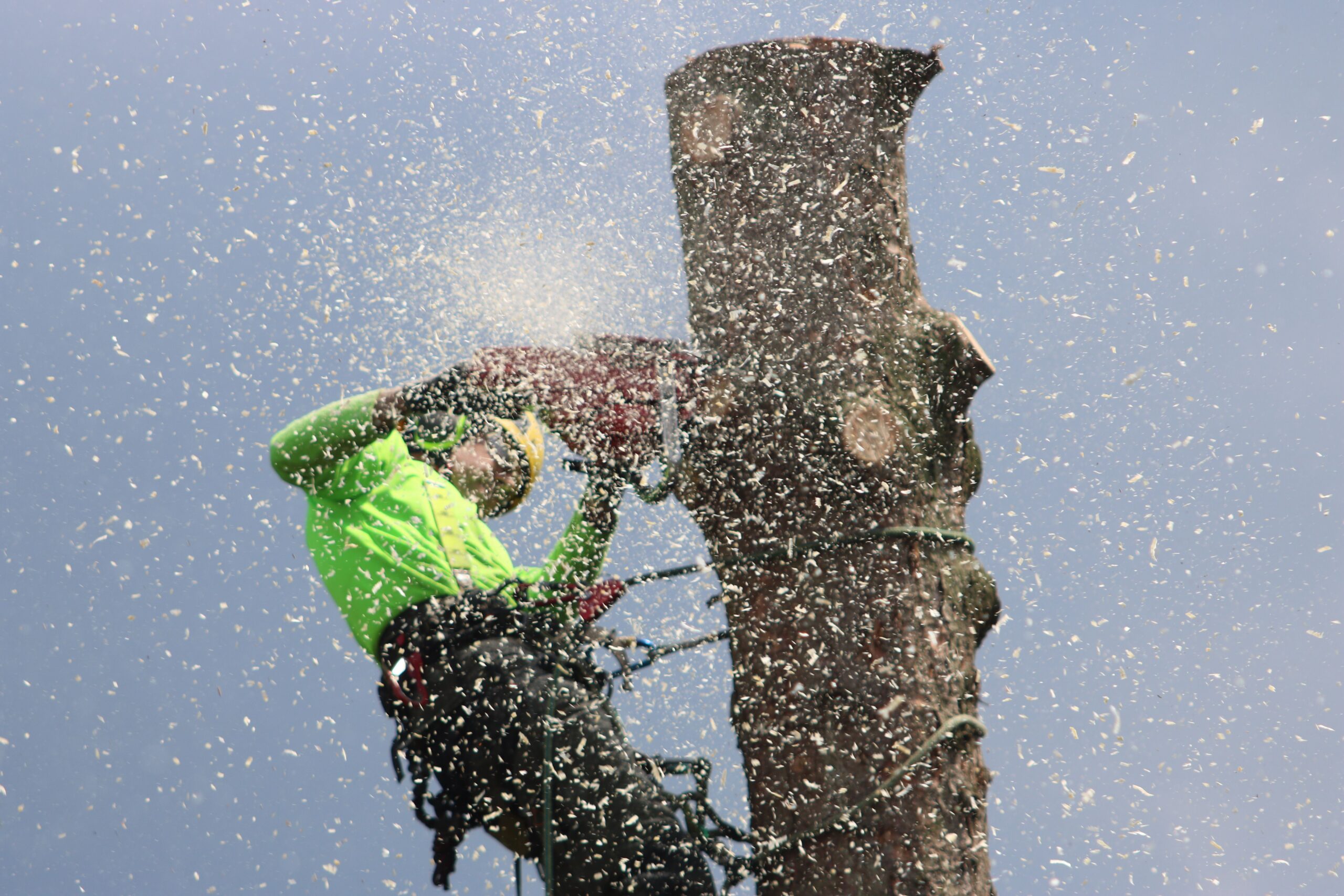
A professional arborist can do things you cannot do from the ground with a pair of binoculars. They climb or use a bucket truck to inspect the upper canopy, where most of the dangerous deadwood hides. They evaluate branch attachments, check for internal decay (sometimes using diagnostic tools like a resistograph), and assess root stability.
The most common storm-prep service is deadwood removal and structural pruning. This means removing dead, dying, and weakly attached branches, then selectively thinning the canopy to reduce wind resistance. A well-pruned tree lets wind pass through instead of catching it like a sail.
For trees with structural issues that do not warrant removal, cabling and bracing systems can add support. A steel cable installed between two co-dominant stems, for example, holds them together during high wind events and prevents the split that would otherwise occur. Cabling is not a permanent fix for a failing tree, but for a tree with one specific weakness, it can extend safe life by many years.
In cases where a tree is too compromised to save safely, the arborist will recommend removal before the storm does the job unpredictably. Proactive removal is faster, cheaper, and far less dangerous than emergency removal after a failure.
How Much Does Pre-Storm Tree Work Cost?
At Urban Tree, we have a $500 minimum for tree services in the Chattanooga area. Pre-storm pruning and deadwood removal on a single large tree usually falls within the range of a standard pruning job, depending on the size and condition of the tree. Multi-tree properties will cost more, but the price is always less than what you would pay for emergency removal and property repairs after a storm.
For context, the Insurance Information Institute reports that wind and hail damage claims average over $12,000 per claim in the United States. A pre-storm tree inspection and pruning for a fraction of that cost is one of the smartest investments a homeowner can make heading into spring.
What Should You Do During and After a Storm?
During a storm, stay inside and away from windows. Do not go outside to check on trees while wind and lightning are active. Trees and limbs can fall without warning, and downed power lines near fallen trees are a life-threatening hazard.
After the storm passes, do a visual inspection from a safe distance. Look for hanging branches (called hangers or widow-makers) that are caught in the canopy and could drop at any time. Look for leaning trees that were not leaning before. Look for downed limbs blocking driveways, sidewalks, or utility lines.
Do not attempt to remove large branches or fallen trees yourself, especially if they are near power lines. Call your utility company first if lines are involved, then call a professional tree service for removal. At Urban Tree, our team handles storm damage response across the Chattanooga area, and we have the crew size and equipment to mobilize quickly when storms hit.
How Can You Protect Young Trees from Storm Damage?
Young trees are more flexible and less likely to suffer catastrophic failure in a storm, but they can still sustain damage that affects their long-term health and structure. Proper staking during the first year after planting helps establish a straight trunk, but stakes should be removed after one growing season. Leaving stakes on too long prevents the trunk from developing the taper and strength it needs to stand on its own.
Structural pruning on young trees every 2 to 3 years is the single best thing you can do for storm readiness. Correcting a co-dominant stem on a 3-inch-diameter tree takes 10 minutes and costs very little. Correcting the same problem on a 30-inch tree may not be possible at all.
Proper mulching and watering during the first few years also helps young trees develop strong root systems. A well-rooted tree is an anchored tree, and anchoring is half the battle in a windstorm.
Frequently Asked Questions
When should I schedule a pre-storm tree inspection?
In the Chattanooga area, late winter or early spring (February through March) is the best time. This gets ahead of the spring storm season that runs from March through June. Scheduling early also means your arborist can do any needed pruning while the tree is still dormant, which is the least stressful time for the tree.
Can I just remove dead branches myself?
Small dead branches within arm’s reach from the ground can be safely removed with hand pruners or a pole saw. Anything above 10 feet, anything thicker than 4 inches in diameter, or anything near power lines should be handled by a professional with proper equipment and insurance.
Does Urban Tree handle emergency storm damage?
Yes. At Urban Tree, we provide emergency storm damage response across the greater Chattanooga area, including Lookout Mountain, Signal Mountain, Ooltewah, Collegedale, Soddy Daisy, and all communities within a 70-mile radius. Our 55-person team can mobilize quickly for large-scale storm cleanup. Call (423) 322-9236.